
Site Reliability Engineering (SRE) Support for System Infrastructure
- Akshay Bhide

- Jul 14, 2025
- 3 min read
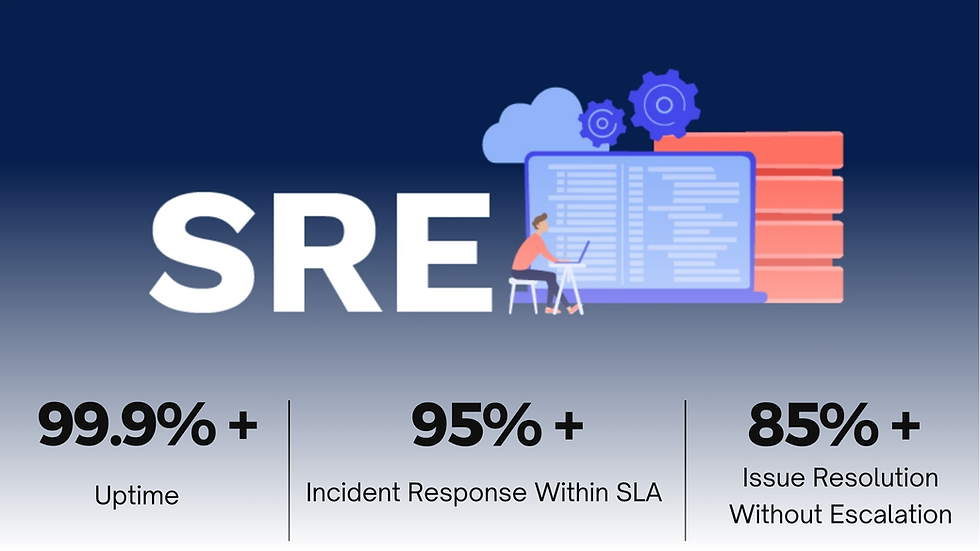
Operational Excellence for Service-Driven Enterprises
As businesses increasingly deploy services and in production environments, the reliability and uptime of servers have become a critical need. These workloads are often hosted in hybrid setups, including dedicated data centers and public clouds, where even brief outages can impact performance, user trust, and business outcomes.
To meet these demands, a dedicated Site Reliability Engineering (SRE) team provides comprehensive support, combining real-time incident management, infrastructure optimization, and operational discipline to maintain high availability, typically targeting 99.9% uptime.
The Whileone Approach to SRE Excellence

At Whileone, we specialize in keeping critical system up and running with minimal disruption. Our team blends hands-on expertise in Linux, server management, and cloud platforms to deliver consistent, high-availability support.
From alert response to root cause analysis and resolution, we follow a disciplined SRE approach that ensures incidents are handled swiftly and systematically. We take pride in being the steady hand behind your infrastructure proactive, and reliable.
Core Capabilities and Technical Expertise
The SRE team operates with a diverse skill set tailored to high-performance, always-on environments:
Operating Systems & Systems-Level Engineering:
Deep understanding of Linux-based systems including process management, disk and memory diagnostics, kernel tuning, system services, networking, and security configurations.
Physical and Virtual Server Management:
Experience with both bare-metal server environments and virtualized compute platforms, ensuring reliability from hardware up to the OS and service layer.
Cloud and Hybrid Infrastructure:
Proficient in managing cloud-native workloads and integrating cloud services with on-premise infrastructure across platforms such as AWS, Azure, Google Cloud, and Oracle Cloud.
Monitoring and Observability:
Skilled in leveraging observability stacks to monitor key metrics, application health, and system-level behavior, enabling proactive detection and rapid triage of issues.
Process Engineering and Benchmarking:
The team implements standardized incident handling workflows and continuously refines processes to improve detection, diagnosis, and recovery times.
Full Stack of Operational Support (L1–L4):
The team provides structured, in-house coverage across all support levels, from basic alert triage (L1), to systems analysis (L2), code-level debugging (L3), and infrastructure-level resolution or architectural remediation (L4).
Cross-Functional Collaboration:
Workflows are integrated with enterprise-grade tools that support alerting, team coordination, ticketing, documentation, and shift-based communication.
Shift-Based Support and Observational Handoffs
The team operates in rotating shifts to ensure 24/7 coverage. Each shift is responsible for ongoing incident management, proactive health checks, and noting key system behaviors or deviations.
At the end of each shift, outgoing engineers document their observations. The first shift of each day consolidates these notes into a comprehensive report, highlighting unresolved issues, recurring patterns, and system performance trends. This ensures that both technical and leadership teams remain informed and aligned.
Structured Incident Response Lifecycle

Alert Detection & Acknowledgement: Monitoring tools flag anomalies; engineers acknowledge and initiate an investigation immediately.
System Diagnosis & Log Review: Teams inspect logs, resource metrics, and system health to identify stalls, failures, or contention.
Collaborative Communication: A live incident thread is established to coordinate response and ensure full team visibility.
Corrective Actions: Engineers take steps like restarting services, isolating nodes, or reallocating load to stabilize systems.
Documentation & Run-log Update: The incident is formally logged with actions and findings for traceability and future reference.
Escalation When Required: Complex issues are smoothly handed off to higher-tier specialists with full context and diagnostics.
Operational Readiness and In-House Autonomy
All support services from the initial alert handling to the most advanced system-level debugging are managed by a fully autonomous in-house team.
This includes:
Immediate L1 triage and alert response.
Deep L2 and L3 systems troubleshooting.
L4 infrastructure decision-making and optimization.
With expertise spanning operating systems, cloud platforms, observability, automation, and performance engineering, the team is self-sufficient and minimizes external dependencies. This allows for faster resolution times and better control over long-term infrastructure health.
This Site Reliability Engineering function provides robust operational support across hybrid and cloud-native environments. With a combination of hands-on technical depth, well-defined processes, and structured escalation paths, the team ensures stability, uptime, and resilience for complex production systems.


Comments