
Choosing the Right Cloud Expense Management Tools

Managing cloud expenses effectively is no longer just a finance problem; it’s an operational necessity. As cloud adoption scales, tracking and optimizing costs across distributed engineering teams becomes incredibly complex. Selecting the right cloud expense management tool helps organizations gain visibility, curb runaway spend, and maximize their infrastructure investments. But with dozens of platforms on the market, how do you separate high-level dashboards from tools that actually drive engineering action?
Let’s explore the key factors, frameworks, and practical steps for choosing a tool that aligns with both your finance goals and engineering workflows.
Understanding Cloud Expense Management Tools
Cloud expense management platforms are designed to monitor, analyze, and optimize cloud spending. They break down native cloud billing data to provide insights into usage patterns, identify cost-saving opportunities, and enforce budget controls.
While legacy tools simply report on historical data, modern solutions focus on actionable optimization. Core features typically include:
Cost Allocation & Tagging: Assigning infrastructure costs directly to specific departments, products, or engineering teams.
Budgeting & Forecasting: Setting spend thresholds and using historical data to predict future cloud bills.
Anomalous Spend Alerts: Real-time notifications when a rogue resource or misconfigured pipeline spikes costs.
Rightsizing Automation: Recommending or automatically executing shifts to smaller, more efficient instance sizes or scheduling shutdowns for idle environments.
The ideal tool shouldn't just aggregate data; it needs to translate complex multi-cloud bills into clear, bite-sized tasks for developers.
Critical Factors When Evaluating Tools

When performing a cloud cost management tools comparison, look beyond basic cost dashboards and evaluate platforms against these operational requirements:
Granular Multi-Cloud & Container Support
Most enterprises rely on hybrid or multi-cloud environments (AWS, Azure, GCP). Your tool must unify these streams into a single pane of glass. Furthermore, if you run microservices, ensure the tool drills down into Kubernetes cluster layers (namespaces, pods, and requests) rather than just tracking the underlying virtual machines.
Integration with Engineering Workflows
This is where traditional tools fail. If a tool requires your developers to log into a separate finance dashboard to see savings recommendations, they won't use it. Look for platforms that integrate directly with existing IT and development pipelines, such as Jira or Slack, so cost optimization becomes part of standard sprint cycles.
Granular and Flexible Cost Allocation
Accurate cost allocation is the foundation of financial accountability. The tool must handle messy, real-world tagging environments, mapping shared resources (like database clusters or data transfer fees) equitably across various teams and projects.
Non-Disruptive Automation Features
Automation reduces manual overhead, but it must be safe. Look for tools that detect idle resources, suggest scheduled shutdowns for non-production environments, and offer performance-benchmarked rightsizing options so you never sacrifice speed for savings.
Transparent Pricing Models
Some vendors tie their pricing to a percentage of your total cloud spend. This creates a conflicting incentive: the more money they save you, the less they make. Prioritize tools with transparent, predictable pricing tiers based on scale or feature sets rather than a tax on your cloud bill.
The Landscape: Legacy Platforms vs. Native Tools
Cloud Providers (Native) [e.g., AWS Cost Explorer, Azure Cost Management]: Best for single-cloud setups and basic budget tracking. The catch is that they lack multi-cloud cross-visibility and default to vendor-biased infrastructure recommendations.
Enterprise Financial Legacy [e.g., CloudHealth, Cloudability]: Best for massive enterprises focused solely on high-level executive FinOps reporting. The catch is that they often feature clunky UIs, remain isolated from developer workflows, and carry a high cost of entry.
Next-Gen Developer-Centric [e.g., CloudNudge]: Best for modern tech teams, multi-cloud setups, and containerized infrastructures. They focus on generating actionable engineering tasks rather than static financial accounting.
How to Systematically Execute Your Evaluation

To choose the best fit for your organization, follow this structured evaluation process:
Define Your True Objectives: Are you trying to reduce immediate cloud waste, fix a broken tagging governance policy, or provide multi-cloud visibility to your executive team?
Audit Your Current Infrastructure Stack: Document your cloud providers, container usage, and internal toolsets (e.g., Jira, Confluence, CI/CD tools) to ensure ecosystem compatibility.
Request Dev-Focused Demos: When viewing vendor demos, bring an engineering lead into the room. Don't just look at the executive financial graphs, ask to see exactly how an engineer receives and executes a rightsizing recommendation.
Run a Controlled Proof-of-Concept (PoC): Connect candidate tools to a single non-production account or cluster. Evaluate how cleanly the platform surfaces hidden waste and check the accuracy of its recommendations over a 14-day window.
Best Practices for a Successful Implementation
Once you have selected a platform, maximize its ROI by establishing clean cloud hygiene:
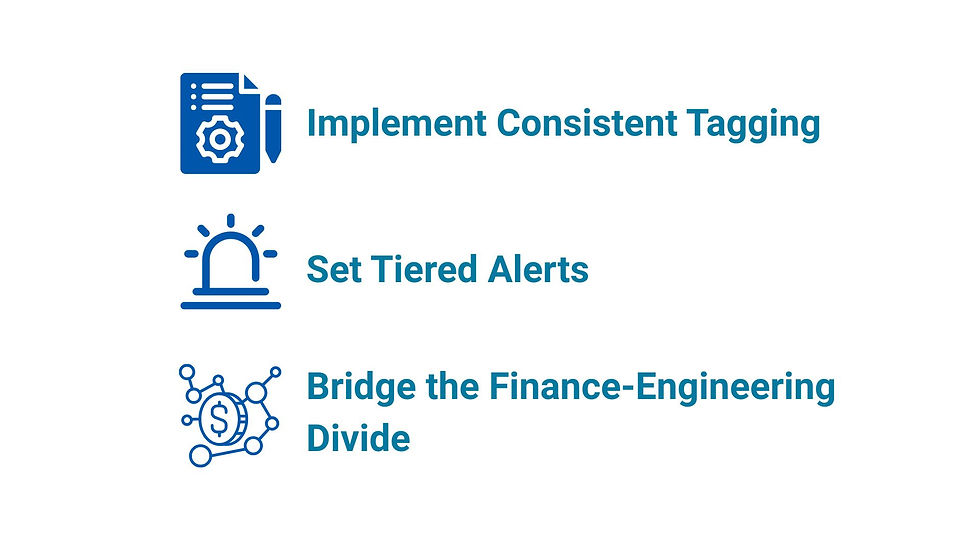
Implement Consistent Tagging: Build a standardized, automated tagging policy (e.g., Owner, Environment, Project) before rolling out the tool to ensure clean data parsing.
Set Tiered Alerts: Configure budget alerts to trigger progressively (e.g., at 50%, 75%, and 90% of expected monthly spend) to catch anomalies before they impact the bottom line.
Bridge the Finance-Engineering Divide: Create regular, cross-functional review sessions. Use the tool’s data as a shared source of truth to align engineering velocity with financial guardrails.
Moving Forward with Cloud Cost Control
Choosing the right cloud expense management tool is a foundational step toward long-term operational efficiency. By selecting a platform that satisfies finance requirements while actively respecting engineering velocity, you turn cloud cost optimization from a monthly headache into an ongoing competitive advantage.


Comments